International Women’s Day – My Perspective on #BeBoldForChange


20170227_144436This is an important day and my post is a bit longer than usual.  I ask you to read, to comment, and to share.

I would love to tell you that life is perfect for me.  I would also love to tell you that I haven’t wondered what my life would be like as a man, especially while I have been here in patriarchal India.  Unfortunately, I could not escape my gender even if it were possible. In America, even before our calamitous election broke open the seal that kept the overt racism and nationalism under a flowing canopy, I knew my gender was an issue for some.  More importantly, it seemed my race and color were even more offensive to others.

As a professional disaster and crisis manager, there have been numerous occasions where my competence and ability were overlooked, ignored, disregarded, or questioned in underhanded and covert ways.  I have been asked what happened to my Indian accent or where did I learn such good English.  When I tell people that I am an Army Veteran, they ask me if I meant the Indian Army.  I haven’t been asked what tribe I belong to or where my dot is in a very long time but they have asked how I could have served as a soldier with just a green card.   These are some of the more minor things, relatively speaking, of course. Unfortunately,  last year, I experienced some of the worst discrimination of my life and it made me angry. To be clear, I am still angry about it today but I am choosing to do something positive rather than just stewing in the anger.  Until March of 2016, I had no idea this kind of behavior had an official name – Racial Microaggressions.

When I realized there was an official name for this behavior and researchers like Dr. Derald Wing Sue have been writing about this for years,  I was astonished.  I had spent a great deal of time wondering if I was too sensitive or misconstruing any of these situations.  The first article I read was one Dr. Sue wrote in 2007 but I was reading it in 2016.[i]  None of what happened was my imagination – it was real – and now I had research to point to as proof.   Although I was ecstatic about this validation, I realized that identifying microaggressive behavior or discussing any kind of racial or gender discrimination would make me vulnerable to further labeling by my colleagues.  My fear proved to be correct in some cases and I was told by a few of my white colleagues that there was no race issue and I was just “overthinking” matters and being “too sensitive”.  I started wondering if I was like the proverbial hammer that thinks everything is a nail. Then I had an epiphany.  This is exactly what racial microaggressive behavior does to a person.  You doubt yourself.   No more of that for me.

Another way to think about these slights is to recall times when someone was accused of playing the race card. How did you feel about it?  Did you automatically side with one person or another?  The danger here is in assuming every white person is a racist or that every black or brown person is angry or militant.  I am writing about racial microaggressions on International Women’s Day because others regularly minimize my perspectives and experiences and I do not want to live a life where I cannot speak up for myself or others. Rather than engaging in destructive or violent ways, I would rather approach this issue through education and awareness.   No matter the reason for the behavior, I must remind myself that I am a sentient being with education and experience.  I am capable of recognizing discrimination, both direct or indirect.   More importantly, I can educate others about racial microaggressions or microaggressive behavior.

It might seem that on International Women’s Day 2017, I should be writing about reproductive freedom, gender-based violence, or societal acceptance of domestic violence or marital rape.  I regularly advocate for better laws and societal attitudes for the aforementioned issues but today, I want to focus on speaking the truth about what we experience in our lives in our respective genders and colors. Many routinely experience this but it takes courage to stand up for ourselves and to acknowledge the discrimination around us.  As we spend our days supporting the causes near and dear to us, we should recognize microaggressive behavior when it is used to minimize us or our efforts.   We should learn more about this, so we can help make the world a better place and #BeBoldForChange.

[i]Sue, D. W., Capodilupo, C. M., Torino, G. C., Bucceri, J. M., Holder, A. M., Nadal, K. L., & Esquilin, M. (May-June 2007). Racial Microaggressions in Everyday Life Implications for Clinical Practice. American Psychologist, 271-286.


Where’s the Connectivity?


My parents and I have been traveling to more northern parts of India since the 15th and getting to know our Motherland a little bit more.   Before I left, I had planned to post stories about each place we visited within a day or two of that site. Alas, our travel schedule and the dratted, inconsistent – sometimes nonexistent – internet connection has foiled my plans. I found myself getting quite anxious about it as a blog should have regular postings.  However, this is India and in India, you roll with it.  It turns out that Wi-Fi is not important at every hotel in India.  The best Wi-Fi we had was in Mysore (Karnataka State).  Everywhere else, the Wi-Fi did not even extend into our rooms.   Apparently, this is common here.   For someone who is used to reading from website articles that are constantly refreshed and then sharing them just as quickly, my usual attempts at sharing via my social media platforms has been frustrating.

When I get back to Kerala with our amazing Wi-Fi at home, I promise more postings with fabulous photos of our adventures in Incredible India.  Until then, I beg your indulgence and ask you to check me out on Facebook as Susamma Seeley  or at Twitter as @seeleysue where I have had more success posting and sharing.  The connectivity is so poor here that it took ten minutes to hyperlink this for you.  Sigh…… I return home next week and will begin posting immediately.  Look for multiple posts following my return with as many photos as I can upload.   See you all soon!

I am heading North!  

20170212_120227

On Wednesday morning, my parents and I are starting a two-week trip to explore more cities in India.   We start in the state of Karnataka with Mysore and Bangalore and make our way to Goa, and then up north to Delhi to be within driving distance of the Taj Mahal in Agra, and the architecture of Jaipur.   I have been dreaming about this trip for years. Will I be able to feel the love Shah Jahan had for Mumtaz when he had the Taj Mahal built?  How will I feel as I walk through Tipu Sultan’s Palace or Brindavan Gardens in Mysore? Are the beaches of Goa as lovely as they say? How pink is the Pink City of Jaipur? How much can I find at Chandni Chowk? Finally, how different is the food of North India compared to Kerala? Follow along as I get the answers to my questions and bear witness to a nexus of history, faith, and culture.

lonely-planet-map-of-india


The Brown Girl and Her Languages

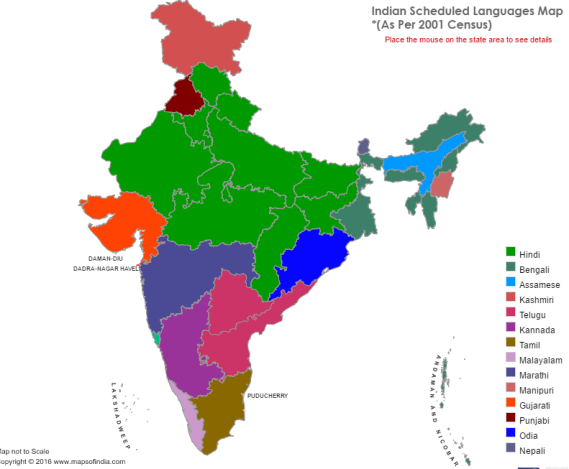
India has twenty-nine states and seven union territories with 461 languages with fourteen already extinct.    From the north to the south, there is no single language spoken by everyone, but of the 461, there are twenty-two major languages. The Constitution of India recognizes these twenty-two languages as the Scheduled Languages.  Check out the link to see the interactive version of this map to see the locations and numbers for speakers of these languages.

One of my goals for this trip was to gain conversational proficiency in Malayalam, Hindi, Tamil and Urdu. I strategically selected these languages for the prior exposure I had plus potential future use. I was born in the state of Kerala where we speak Malayalam.  The state to the east of Kerala is Tamil Nadu where Tamil is spoken.  Hindi and Urdu are spoken primarily in the northern states but anyone who has seen a Bollywood film or listened to the music has probably heard both Hindi and Urdu since they are similar when spoken. I have seen films in all four languages plus listen to music in all four.  Hindi and Urdu are similar and so are Malayalam and Tamil.  As I study these  four languages, I am adding to my existing knowledge rather than learning them all from scratch.

Of course, I am not doing this all by myself.  I have separate tutors for Malayalam and Hindi with books for all four languages, a ton of flashcards, and volunteers who will have conversations in all four languages. Fortunately, my tutors are very patient with me as I learn.  Often, I find myself wanting to answer in other languages.  For example, my Hindi teacher will ask me a question in Hindi but I want to answer in Spanish. During my Malayalam sessions, I want to answer everything in Hindi.  Unfortunately, this has happened to me before.  Years ago, when I was stationed in Germany, I took a fast track German class with other soldiers to learn enough to get around off post. When folks spoke to me in German, the Spanish I learned in high school would leap out of my mouth. I could never explain it. We all get a good laugh out of this quirk of mine but I am grateful that I have been exposed to so many languages.  When I return to the states at the end of May, I will be able to have conversations in five languages.  If you speak any of these languages, let’s chat. Until next time.

maps-of-india-languages

30 Days in…Holy Patriarchy

I arrived in Kerala on January 3rd and it is already the February 3rd. In the United States, today is National Wear Red for Women Day and Punxsutawney Phil saw his shadow yesterday. I think someone should sneak him over here.  He would not have to hide from the sunshine and he is already used to the attention. Best part for Phil is that no one will ask him if he is married or where his kids are.  Since I have been here, people want to know where I work and where my husband and children are.  It is annoying, but it is the prevailing construct to categorize family, friends, and strangers.  I get it.   Frankly, I expected more comments about my weight but it seems with the advent of processed or fast food in India, more people are larger.

Apparently, being overweight is not as bad as being unmarried.   Of course, there have been people who asked me why I was not married. The unspoken message is that I look older (read this as past marriageable age) and should be married especially since my younger siblings are married and have children.  Naturally, they have this information because they know my parents have two other children and three grandchildren. The American in me wants to tell them to mind their own business, but since my actions reflect on my parents, I must behave.  So, I take a breath and say jovially that I am not interested in getting married. They give me a funny look since I am spouting heresy.  Maybe I am a heretic here, but if I had a family, I would not be spending January to June just to learn four languages, travel, and do disaster preparedness research in India. I would be busy raising my family.

Consequently, I ignore a great deal here.  However, Kerala, my home state, feels like the capital of displays of casual patriarchy, racism, and sexism, so I can only wonder about the other states in India. Many of the men here act like we are less than them because we had the misfortune to be born women.  They are often dismissive or condescending as if my poor brain could not handle kind or respectful words. I understand how women must live here, so I am learning to swallow my disgust at the blatant disrespect shown to me as a female.  I guess the language barrier is a good thing.  If someone makes a remark that I find sexist or racist, I can act like I did not understand.  This doesn’t always work, but hey, this brown girl has to use what she has available.      As I explore more of India, I am sure I will encounter more of this behavior, but that will not stop my adventures.  Hope you will stay with me.

What the #WomensMarch Means for this #BrownGirl

      The #WomensMarch was a week ago and I am still seeing photos and stories on my social media feeds about the response across the world. There was no march in Kerala, South India where I am now.  When the #WomensMarch took place in America, it was dark in Kerala.  I am sure I was not the only woman who wanted to support those who were marching, but, in India, it is not safe for women to be out after dark. Men must chaperone the women otherwise they risk things happening to them.

      Speaking of things just happening to women, on December 31st  in the city of Bengalaru (formerly Bangalore)in Karnataka, many of the women who were out celebrating New Year’s Eve were allegedly molested by  some of the men in the same crowds. In an article in the Indian Express, the Karnataka Minister  was quoted as saying that these things happen.  When I read that, I inferred that assaults on women are expected and should be accepted as our fate.  This Brown Girl rejects that notion.  As an Indian American making India her temporary home, I will never just accept that any man can assault me or any other woman and get away with it.  Unfortunately, most do get away.  According to the Indian National Crime Records Bureau, there were 34, 651 cases of rape reported with just over 29% convicted.    Given these numbers, the #WomensMarch is even more important than we may have initially thought.  There were many women, but there were also many men who were there.  

      During the last week, as I watched the footage of the #WomensMarch, I realized that I looked at it from the perspective of a very independent women who has lived most of her life in America where I was relatively safe if alone at night outside of my home.  Since this is not the case here in India, those who were marching across the world were marching for all of us.  Campaigns like the #WomensMarch and #IWillGoOut represent the struggle to normalize a woman’s right to have the same freedoms and rights as a man. In India, the majority of men do not support women’s rights and freedoms, so it was quite incredible to see the images of so many women and men (supporting the women in their lives) standing up for love and equality all around the world.  I stand in solidarity with them from across the ocean and pledge to make every day the march that cannot be ignored. #womensmarch #Solidarity #Browngirlspeaks

washington-overall-TC-1254.jpg

Source – NY TIMES

 Inauguration Day Thoughts from India

Inauguration Day is here again, but today I am not excited to see anything nor am I feeling positive about the incoming administration.  On November 9th, I felt such despair and shock that I spent most of the day crying.    I imagine there were lots of folks who either did the same or perhaps they were rejoicing that their candidate won.   Either way, as my brain and heart ran through a gamut of emotions much like someone who grieves a death.   I spent weeks grieving and was vocal about my feelings on my social media accounts.   There were varied comments about President Obama, Hillary Clinton, and Donald Trump but my post today is not about debating the merits of one person versus another.  There is something more at stake here.

In the weeks following the election, I found the attitudes of people on both sides of the argument to sometimes be dismissive or disrespectful of what the other side might be experiencing.   It seemed all decorum had been lost.   After a particularly contentious campaign and election, some expressed unfettered hatred of those who were different from them in some way while others including myself shared fears.  I am talking here about those who might be part of the LGBTQ community,  Muslim, Christian, Jewish, anti-abortion, pro-choice, Democrat, Republican, Independent, black, white, brown, or whatever group(s) you may belong to. While none of us agree on everything, we are all people – human beings.

20170116_131307.jpg

Whichever side you may be on, in a few hours, we will have a new president.  Although he is a different man than President Obama, we will still be the same people we were before and after the election.  We can still choose to do the right thing and treat other people with respect.  I am far from perfect as most of us are but there are two things we have in common though.  We are responsible for our own thoughts and our own actions.

On this inauguration day, let us remember to be kind and respectful of others while we express our feelings and support for our causes over the next four years. Given the beliefs and practices of the incoming administration, many will lose the freedoms and rights they have gained in the last eight years. Many will be targeted and many are fearful of what life may be for them. If you are reading this and think they are being silly for feeling this way, your opinion does not negate their feelings.  For those who may mistake respect and kindness for weakness, let this be a challenge to you.   Denying what I say does not invalidate my message.


Martin Luther King & Brown Girls

On this Martin Luther King Day in India, my thoughts are reflective and appreciative of the man who Martin Luther King was and what he represents. In his fight for equality for people of color, I wonder where I fit in. As an Indian American, I am not black nor am I white. Where does this leave me?  Simply, I am a woman of color and live my life as such. For the Indians, I am a Malayalee, a person from the south Indian state of Kerala, and I am considered medium dark on the Indian spectrum of color.   For the Americans, I am not white, so there are times when I go into stores or restaurants across the country where I am often ignored if I am by myself.  When I talk about these incidents, my friends often hear me remark that I have absorbed all the light in the room and have become invisible.  It’s an odd notion but on the color spectrum it makes sense. White is the absence of color and black is the absence of light, dark and nebulous.

When I was young, I always knew that I was dark by Indian standards, but it wasn’t until I was the only child of color in the fourth grade that my classmates taunted me for being different from all of them. They said mean things and made sure to keep physical distance between me and them.  By the time, I reached high school, I understood that I was not acceptable to some because I was too dark. Coincidentally, my fellow white students found dark skin color acceptable only when they got tans during winter break. Sometime after winter or Easter break, as their tans were fading, I used to make fun of these students by remarking how my tan was fading.  Even back then, I was sassy and irreverent when facing overt racism but it was a long time before I realized that covert racism also existed.

Consequently, the world got more complex and in the last ten years, we Indian women started calling ourselves brown girls. I used brown girl because being color blind is not an option in my world.  I am not sure what Martin Luther King would think about the world today. This brown girl recognizes that as long we are standing against injustice and inequality, we will move forward together toward the world Martin Luther King envisioned.


As I settle in…

After eight months of planning for a six-month trip, I have been here in Kerala, India for ten days now and I am excited to be here.   I am not as plugged in as I would like to be since our Wi-Fi does not work consistently and my cell phone service is sparse at best. The real issue is that I am going through a withdrawal of sorts from instant access to my social media or to the internet.  For the old me, this would have been a huge problem but I have plenty to do while I am here.

For those of you who are wondering if I have unpacked, all three of my large suitcases were completely unpacked within twenty-four hours.   This was important for me since I would be here for six months.  Setting a new routine and getting comfortable in my, albeit temporary, space made my forty-something heart feel good. For the first time, in over twenty years, I unpacked and put away everything right away. Yes, you read it correctly.   With all my 10+ past moves, I never unpacked completely and had full boxes or as I like to call them, “Deal with it later” boxes left over.   It fit my nomadic lifestyle but I don’t want that anymore.  In my year of doing, I have set new expectations for myself and will work to achieve them.

Let’s talk about my expectations for a moment.  This trip is more than a sight-seeing jaunt.  With all my planning, I included goals and milestones to ensure I made the most of this opportunity and I so glad I did. I considered the coordination in advance for most of what I wanted to do and made lists organized by forward planning, post arrival, and prepping for my return in June.   I approached this trip as if it were my job.   Since my life is more important than any job, why wouldn’t I give myself the dedication and coordination that I give to a job. There were people who teased me for my copious planning, but I am glad I did it my way.  In my year of doing, I promise to listen to myself more.  I have heard it said that luck is when preparedness and opportunity meet.  Well, with all the preparedness I put into this trip, I should be very lucky.

20170113_184610

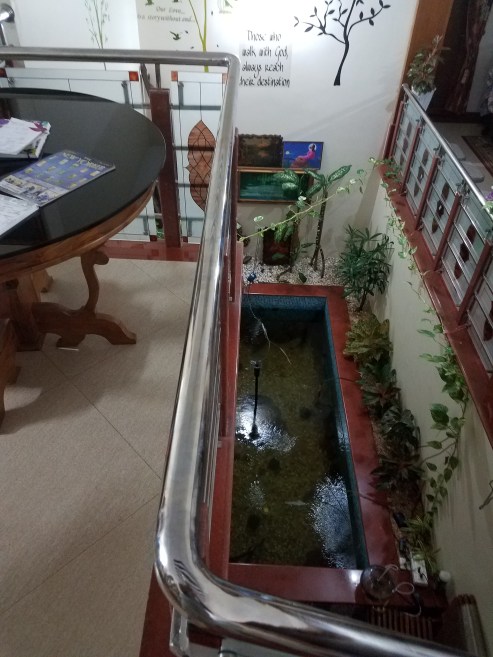
This is my work space overlooking our inside grotto with very tiny sharks and other little fish.

Now That I am here


I landed in Thiruvanthanapuram, Kerala around 3:10am local time on Tuesday, January 3rd. That was about two and half days ago.   Between the effects of nearly twenty hours in flight and the time change, I am still not sure what day this is and I have no idea what is happening in the world. To make matters worse, my electronics are not automatically synced to anything. In fact, without consistent Wi-Fi, I had to turn off most of my notifications and apps to keep the phone from using up the battery. I realize I may sound like a whiny privileged adult with my first-world issues, but those of us who use technology and devices to manage our time and travel are dependent on these conveniences to keep to our schedules and our lifestyles. In my everyday life, the thought of misplacing my phone or having no Wi-Fi terrifies me.

When I was planning for India, I anticipated the lack of consistent internet access but I overestimated my need for technology and devices for life in India.  I thought I would be devastated without constant access.  After two days in country, I realize I am really learning how to live a different life, one without my dependence to technology and devices. As I write this, I am chuckling because I remember when none of us had cellphones or Wi-Fi and we lived happy lives. I did not get my first cell phone until I was a young soldier stationed in Germany. Even then, I barely used my cell phone. That was about sixteen years ago when my life was governed by the work schedule of the Surgical Clinic where I worked at Landstuhl Regional Medical Center.

You might be asking why I am reminiscing about my time in the military and what it must do with moving to India for six months. It seems that I have been shifting from one lifestyle and pace to another for so many years that moving to India for a short time will not be that difficult. In the Army, I learned to train for the job I had to do while anticipating potential changes and I realize that my whole life has been a practice of that. While I wasn’t particularly good at being a soldier, I learned valuable life lessons about adapting to change before the changes engulf me. Moving to India was my choice and so is being less dependent on technology for the next six months.

20170103_072233
The Hibiscus , A  simple  but elegant flower in our driveway.